
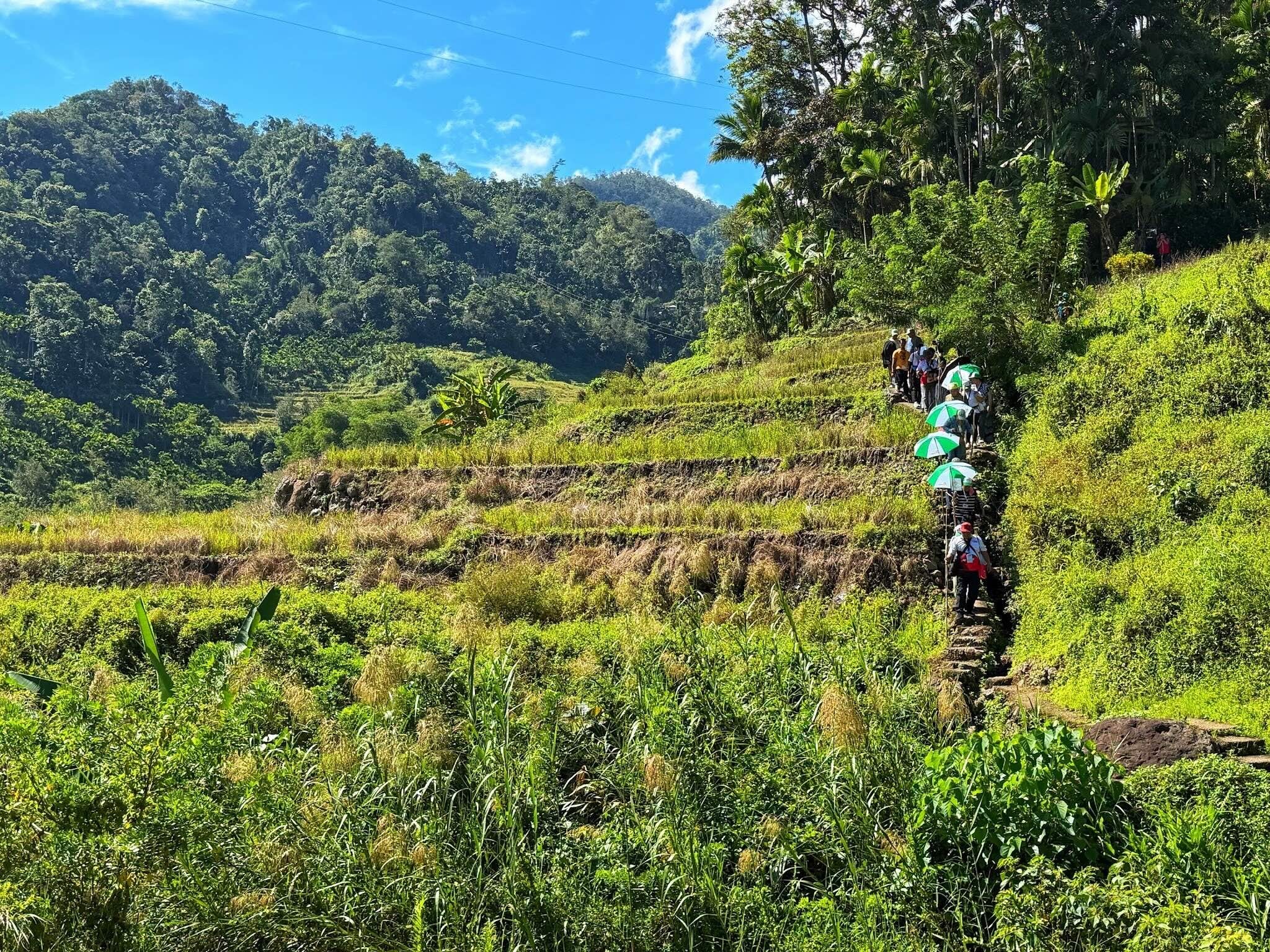
The Ifugao rice terraces of Nagacadan in Kiangan town were resting between harvest and the next planting when visitors arrived in October 2026, their paddies brown and bare rather than the bright green of tourism posters. According to Rappler's travel report, the fields were not neglected; they were simply between seasons, doing what farmland does.
That distinction sits at the heart of a question the Cordilleras now face. The terraces are a UNESCO World Heritage Site, but they are also working farms, and their survival depends less on conservation projects than on people willing to keep farming them.
A first-time guide in Nagacadan
Among those who walked with the visitors was Johntrey Dandan Dinamling, a young local guide leading his first tour of his own village. He had paused his schooling to help with farming, and guiding gave him another way to stay close to the land.
It was my first time to share my knowledge about our village, he told the group in a mix of Filipino and English, nervous but smiling.
He spoke about heirloom rice, irrigation, and traditional practices, sometimes pausing to search for a word while neighbors helped him along. He was not reciting a polished spiel. He was explaining his home to strangers.
I experienced farming, he said simply. For him, farming was not heritage in the abstract. It was work he had done with his own hands.
Dinamling said he wants more visitors to come to Nagacadan, not only for the scenery but because tourism can provide a livelihood and give people reasons to stay in the community. That matters in a place where the future of the terraces depends on people willing to maintain irrigation, repair stone walls, and pass on knowledge that no brochure can teach.
Five clusters, one living farm system
Nagacadan is one of five clusters that make up the Rice Terraces of the Philippine Cordilleras, inscribed on the UNESCO World Heritage list in 1995, alongside Batad and Bangaan in Banaue, Hungduan, and Mayoyao, according to Culturalheritageonline's overview of the site. The site spent more than a decade on the danger list, from 2001 to 2012.
The terraces were built by the Ifugao people, renowned for carving steep mountainsides into stepped paddies, a feat of engineering that Grokipedia's entry on the Igorot people dates back some 2,000 years. The Ifugao kept no written record, and carbon dating has placed parts of the system between the 7th and 16th centuries.
Walking among the terraces changes the scale of what a viewpoint flattens. You begin to notice irrigation channels, soil, stone walls, houses, and granaries, the ordinary work needed to keep the whole system alive. Rice here runs through everything: work, storage, food, ritual, architecture, and the rhythm of the year.
Kiangan's welcome: have you eaten?
Before the group entered a traditional Ifugao house, guides sang a request to lower the ladder: Itetem ta humgopak. The song conveys the feeling of someone coming home after a long journey, asking to be let in, to rest, and to be welcomed.
Kiangan Mayor Raldis Andrei Bulayungan offered his own version of local hospitality the night before.
We don't simply say welcome. We also ask, have you eaten?
Even if visitors say they are full, he joked, someone will probably insist they eat again. He urged the group to try bakkle, a rice cake wrapped in banana leaves, and suggested that calories consumed while appreciating culture should count as cultural education.
His larger point was serious. Tourism, Bulayungan said, should not be only about visiting beautiful places or taking photographs.
It is about connecting with people, understanding their stories, appreciating their traditions, and creating friendships and memories that will last a lifetime.
Visitors also mean income for homestays, guides, food producers, performers, and other small businesses in Kiangan. For a town that wants more tourists without losing what makes it unique, that balance matters.
Why the terraces are not always green
There is a habit in travel of wanting places at their prettiest, and the terraces do not cooperate with that habit. Rice in Nagacadan is traditionally planted once a year. By October, much of the area is between cycles, with paddies resting or being prepared for planting again.
A rice terrace is not failing when it turns brown. It is simply at another stage: planting, growing, ripening, harvesting, clearing, preparation, and rest. Wikipedia's entry on Ifugao notes that harvest festivities once entailed strict taboos on agricultural work, with rice wine and rice cakes marking the rituals.
There is a warning in that history. Reporting by Ocarramedia has noted that in the Cordillera, the agricultural calendar has in some places shifted from farming rhythm to tourist event, with meetings once aligned to planting and harvest now adjusted for visitor itineraries. A heritage site that performs for cameras risks losing the very cycle that made it heritage.
What happens next
The green will return to Nagacadan, and the rice will grow again. For now, the terraces rest, and the land, like the people who depend on it, knows when it is time to work and when it is time to rest.
The question for Kiangan, and for the Cordilleras more broadly, is whether young people like Dinamling can keep finding ways to stay. Tourism can help, but only if it respects the farming calendar that keeps the terraces alive in the first place.
Frequently asked questions
Why are the Ifugao rice terraces brown in October?
Rice in Nagacadan is traditionally planted once a year. By October, the paddies are between harvest and the next planting cycle, resting or being prepared again, which is a normal stage of the farming year.
Which clusters make up the UNESCO World Heritage site?
Five clusters inscribed in 1995: Batad and Bangaan in Banaue, Nagacadan in Kiangan, Hungduan, and Mayoyao, spread across four municipalities in Ifugao province.
How old are the Ifugao rice terraces?
The Ifugao kept no written records, but carbon dating has placed parts of the system between the 7th and 16th centuries, and the engineering tradition is often dated back some 2,000 years.