
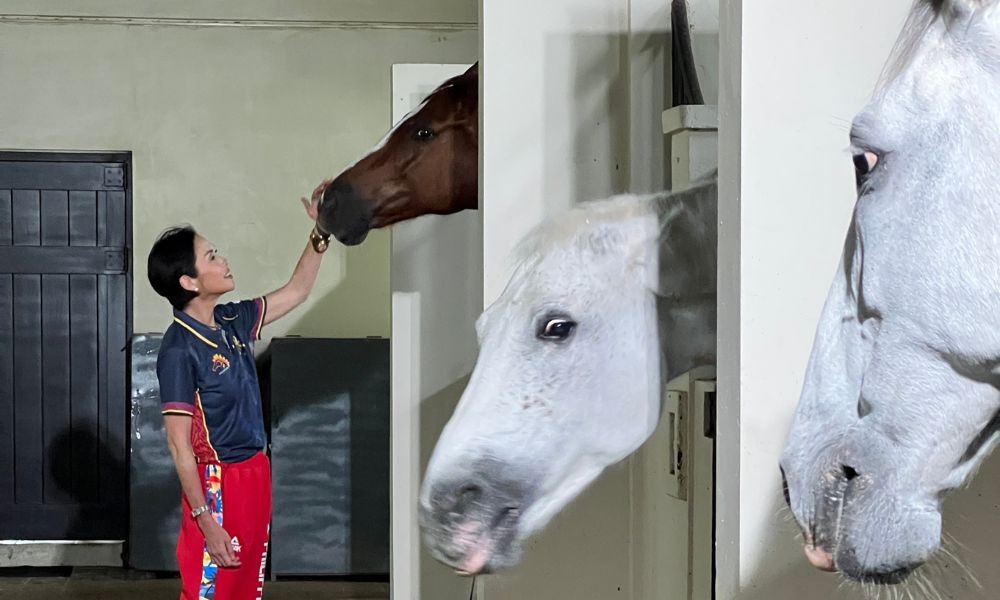
A Filipina physician has become one of the Philippine equestrian team's most trusted allies, not by prescribing medicine but by learning to listen to horses. Dr. Maritess Gozon Viterbo, profiled by GMA Network on October 23, 2026, combines her medical and psychology background with equine bodywork, and her approach helped carry a veteran dressage horse from near-collapse to the 2026 Asian Games.
Her story resonates far beyond the stable. It is a tale of a childhood dream in Baguio's Wright Park, a pandemic career pivot, and a quiet argument that animals competing for national glory deserve the same care we demand for human athletes.
Listening before touching
Viterbo resists the popular label of horse whisperer.
“Actually, more of a horse listener,” she told GMA Network.
That distinction shapes everything she does. Horses are prey animals with senses sharp enough to catch the smallest shift in a person's body language, so Viterbo begins every session by grounding herself and approaching calmly. Then she reads the animal itself: the ears, the eyes, the breathing.
“We were taught how to read their expressions. For example, the way their ears move has meaning. You can also tell from their eyes whether they're stressed or not, even from their breathing,” she said.
It is a skill that echoes what horse people everywhere describe: the animal carries the jump, and the rider's job is simply to put it in the best position, as one equestrian comparison circulated recently puts it. Trust, not force, is the whole discipline.
When a champion horse could not perform
Her most telling case is Lacoste 126, known as Costi, the veteran dressage horse ridden by Olympian Toni Leviste. Viterbo describes him as unusually temperamental, a horse most handlers struggled with. Three years ago she visited him simply to see whether she could help.
“After a few weeks, he became gentle with me. He even started letting me touch his head,” she recalled.
In 2025, while Leviste chased qualification for the Southeast Asian Games, Costi could not reach the required score. Viterbo traveled to Belgium and found a horse gripped by tension so severe that his whole body locked up.
“When he gets mentally stressed, his entire body automatically tightens up. So you might think he's lame even when he's not,” she explained.
On July 19, 2025, Leviste and Costi won the Prix St. Georges dressage competition in Flemalle, Belgium, scoring 68.603% against a 67% qualifying benchmark. Months later the problem returned: just 10 days before Costi's flight to Japan for the 2026 Asian Games, he developed severe lameness that veterinary consultations could not fully resolve. Viterbo flew back to Belgium.
“He was really just tense. After only one session, Toni was able to practice with him almost as if everything was normal,” she said.
Costi resumed training, and the pair competed at the Asian Games.
A kindergarten dream in Wright Park
Viterbo's path began in Baguio, at the pony rides of Wright Park, a place many Filipinos of a certain generation remember fondly. When her kindergarten teacher asked what she wanted to be, she did not say doctor, lawyer, or pilot.
“I said I wanted to be a horse guide at Wright Park,” she told GMA Network.
She graduated as a physician instead, but the pandemic gave her a second chance. Drawing on her psychology background, she enrolled in a 40-week Australian online program in equine-assisted psychotherapy, a practice that uses interaction with horses to support human mental health, an approach that has drawn growing interest among practitioners of animal-assisted healing. During her studies she realized something that changed her direction: before horses can help people, the horses' own needs must come first.
She went on to study equine bodywork, osteopathy, taping, and laser therapy, then blended the best of each into a method of her own.
“I studied all of them and took the best practices from each. Now I have developed my own method,” she said.
Why horse welfare matters to Philippine sport
Viterbo now works with the Philippine equestrian team, and her advocacy carries weight in a sport where the animal's suffering is easy to overlook. Horses, like human athletes, need therapy when their muscles tighten or injuries appear, she said, yet their recovery needs are sometimes forgotten in the push for medals.
“They give so much to humans, even when they are already injured. They still give everything they've got,” she said.
Her point is not sentimental; it is practical. A horse's psychological state affects its movement, its performance, and the safety of the rider on its back. Prioritizing well-being strengthens the partnership between horse and rider, a principle that international racing publications such as BloodHorse recognize as central to the industry's future.
And no two horses, she insists, can be treated the same way.
“They are individuals, just like people. We don't all receive the same treatment, and it's the same with horses. You can't treat every horse the same way,” she said.
For Viterbo, the work has closed a circle that began at Wright Park. She graduated as a human doctor, she said, but now works mostly with horses, which was her real dream all along.
FAQ
Who is Dr. Maritess Gozon Viterbo?
She is a Filipina physician and psychologist who now specializes in equine therapy and bodywork, working with the Philippine equestrian team after retraining in equine-assisted psychotherapy during the pandemic.
Which horse did she help reach the 2026 Asian Games?
Lacoste 126, or Costi, the dressage horse of Olympian Toni Leviste. After one session with Viterbo in Belgium, he recovered from severe lameness days before his flight to Japan and competed in the Games.
How does Viterbo “listen” to a horse?
She approaches calmly, stays mindful of her own body language, and reads the horse's ears, eyes, and breathing to detect stress and build trust before any physical treatment begins.