
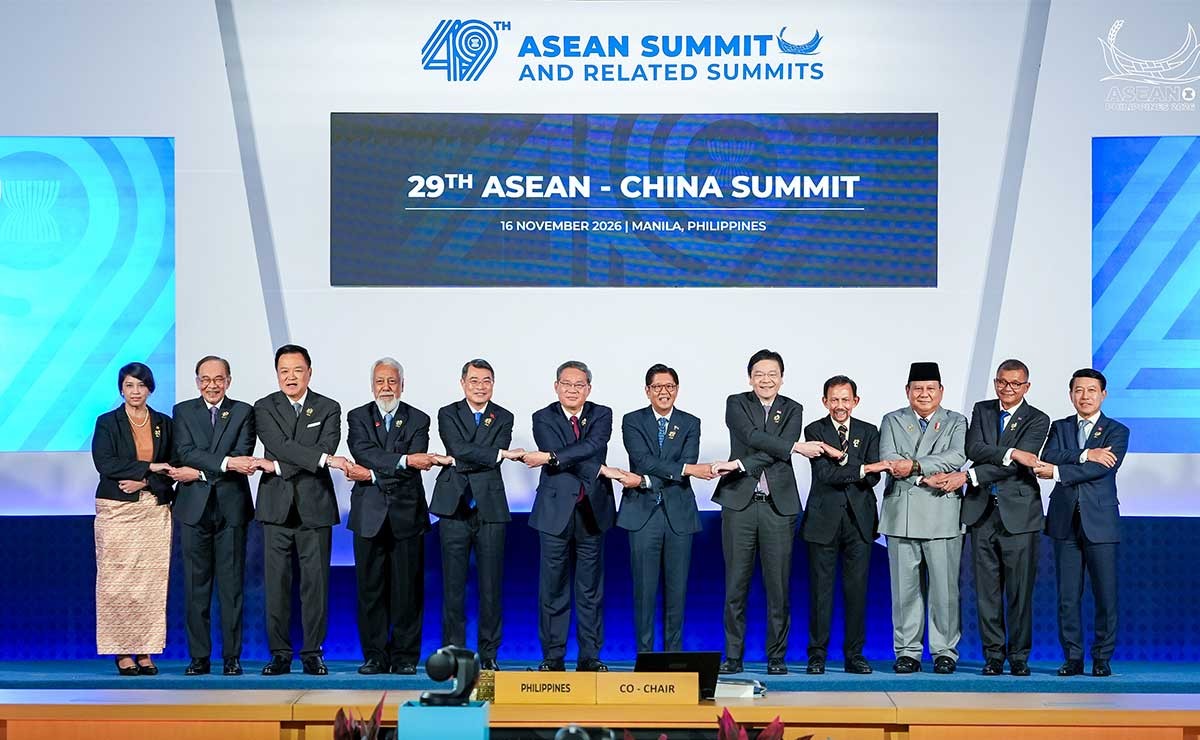
President Marcos and Chinese Premier Li Qiang reaffirmed their commitment to strengthening Asean-China relations on Monday, November 16, as the two leaders cochaired the 29th Asean-China Summit in Manila, part of the Philippines' hosting of the 49th Asean Summit and Related Summits.
The meeting carried double weight: it marked the fifth anniversary of the Asean-China Comprehensive Strategic Partnership and the 35th year of dialogue relations between the bloc and Beijing. Marcos used the anniversaries to press a point that matters deeply to a nation whose fishermen and coast guard crews face pressure in the West Philippine Sea every week.
Marcos anchors anniversary in international law
According to the Inquirer, Marcos told the summit that the milestones should reinforce commitments to international law, not merely decorate them.
“During this anniversary year, our shared commitment to international law and the peaceful settlement of disputes must be reflected in our actions, including through self-restraint, mutual respect, and practical cooperation,” Marcos said.
“Even amid regional and global uncertainties, Asean and China continue to find common ground and pursue tangible cooperation,” he added.
The President noted progress toward a South China Sea Code of Conduct grounded in international law, including the 1982 United Nations Convention on the Law of the Sea, the same treaty on which the Philippines built its 2016 arbitral victory. That ruling rejected Beijing's sweeping claims, and Manila has never wavered from it. The tone on Monday was firm but measured, in keeping with the administration's preference for diplomacy backed by law rather than loud rhetoric.
Trade numbers that reach down to the barangay
Li, for his part, spoke the language of commerce. He told the summit that trade between China and Asean exceeded $1 trillion last year, while trade in the first 10 months of 2026 grew by 29.6 percent. Cumulative two-way investment, he said, has surpassed $500 billion, more than half higher than five years ago.
“Despite such a challenging environment, China-Asean cooperation has maintained strong momentum and scored encouraging achievements,” Li said.
“Although economic and trade restrictions have substantially increased around the world, we remain firmly committed to safeguarding multilateralism and promoting free trade, and endeavor to make the pie of cooperation bigger,” he added.
Those figures are not abstract for Filipinos. China is the country's top source of imports, which means the stability of this relationship touches the price of everyday goods and the materials and equipment that small and medium enterprises, from Cebu furniture makers to Davao agri-processors, depend on to keep workers employed. The Philippine Canadian Inquirer reported that China remains Asean's largest trading partner in a region whose combined economic output exceeds $3.9 trillion.
AI, supply chains and scam-busting on the agenda
Foreign Secretary Ma. Theresa Lazaro, briefing reporters after the talks, said Marcos had concluded “very important” Asean Plus One summits with China, Australia, the Republic of Korea and the United Nations. The Asean-China meeting covered trade, supply chains, support for micro, small and medium enterprises, science and technology innovation, and artificial intelligence, along with cooperation against transnational crime, health, cultural preservation and maritime safety.
The South China Morning Post reported that Li pledged deeper cooperation in artificial intelligence, part of Beijing's push to strengthen technological partnership with Southeast Asia. For a country racing to train its own digital workforce, that opening is worth watching closely.
Cooperation against online scams deserves particular attention from Filipino families. Scam operations using fake job offers have victimized thousands of our countrymen, including workers lured into illegal camps abroad. A joint framework with China, where many of these operations originate, could offer real protection.
Code of Conduct: 80 percent agreed, but no signature yet
The most consequential exchange may have been Li's pledge on the long-delayed South China Sea Code of Conduct. Lazaro highlighted his commitment to “an effective, substantive and early conclusion of the Code of Conduct, which is consistent with the 1982 Unclos.”
For all the goodwill, the numbers tell a sober story. Lazaro said on Sunday that parties have reached provisional agreement on about 80 percent of the draft's paragraphs, up from roughly 50 percent when the Philippines assumed the Asean chairship early this year. That is genuine progress, achieved under Manila's watch.
“Definitely, there's no conclusion yet,” Lazaro said, confirming the code will not be finalized and signed before Manila hands over the chairship to Singapore in 2027.
What still divides the negotiators?
Three issues remain unresolved: the code's geographic scope, definitions of key terms, and whether it should be legally binding. The scope question will determine where the provisions apply, while the legal status question will affect how, or whether, they are enforced.
Lazaro said some Asean members worry that a legally binding instrument could require domestic ratification. “Some have their sensitivities, like if you say that the document is legally binding, there is also a ratification process on the part of certain Asean member states,” she said.
She estimated another five to six months might have been enough to complete the negotiations, but the Philippines will not secure a final agreement during its chairship. She credited Malaysia and China, the code's cochairs, for guiding the process.
Negotiators have also reached a provisional understanding on the code's relationship with the 2002 Declaration on the Conduct of Parties in the South China Sea, the nonbinding framework that preceded it. The new code is envisioned as a guide for conduct and a platform for voluntary maritime cooperation under Unclos. It is designed to prevent incidents from escalating, not to settle territorial and maritime claims.
Four documents signed, one hard question ahead
The summit produced four outcome documents, including a joint statement marking the fifth anniversary of the Asean-China Comprehensive Strategic Partnership, approved by all Asean member states. The Asianet Newsable reported that both leaders reaffirmed their commitment to practical collaboration and regional stability despite global uncertainties.
Here is the honest reading. The trade numbers are welcome news for an open economy like ours, and the anti-scam cooperation could save Filipino families from heartbreak and debt. But words on maritime conduct are cheap if they are not anchored in Unclos and backed by restraint at sea. The President said as much on Monday: commitments must be “reflected in our actions.”
What happens next falls largely to Singapore's chairship in 2027, when negotiators will tackle the geographic scope and the binding question that have stalled the code for more than two decades. Whether Beijing matches its pledge of an “early conclusion” with real flexibility on those points will tell us whether this summit produced more than anniversary rhetoric.
FAQ
What did Marcos and Li Qiang agree on at the Manila summit?
On November 16, 2026, they reaffirmed commitment to strengthening Asean-China relations, marked partnership anniversaries, and endorsed deeper cooperation on trade, supply chains, AI, and a South China Sea Code of Conduct consistent with Unclos.
How much of the South China Sea Code of Conduct is finished?
Foreign Secretary Ma. Theresa Lazaro said parties have provisionally agreed on about 80 percent of the draft, up from roughly 50 percent at the start of the Philippines' chairship, but the code will not be signed before Singapore takes over in 2027.
How big is China-Asean trade?
Li Qiang said trade exceeded $1 trillion last year, grew 29.6 percent in the first 10 months of 2026, and cumulative two-way investment has surpassed $500 billion.