
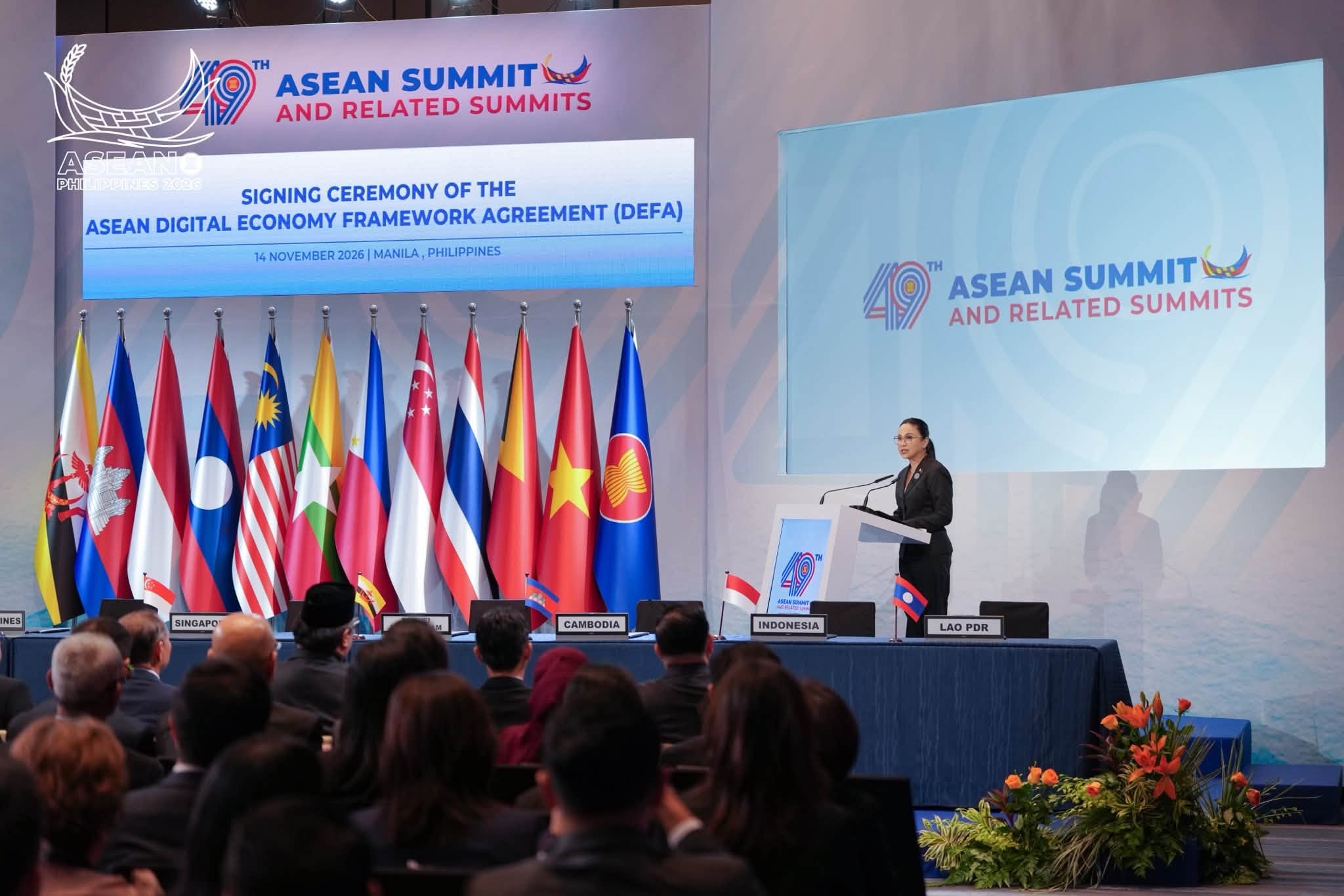
Economic ministers from all 11 ASEAN member states signed the world's first region-wide, legally binding digital economy agreement on Saturday, November 14, 2026, at a ceremony in Pasay City, committing Southeast Asia to a single framework for cross-border digital trade, data flows, and electronic payments.
Philippine Trade Secretary Cristina Roque signed the Digital Economy Framework Agreement, or DEFA, on behalf of the country, alongside ministers and deputy ministers from Cambodia, Brunei, Indonesia, Laos, Malaysia, Myanmar, Singapore, Thailand, Timor-Leste, and Vietnam, according to GMA Network's report on the signing.
What the ASEAN DEFA covers
The agreement reduces barriers to cross-border digital trade, simplifies data transfers, and standardizes electronic payments across the region. For foreign businesses, it means fewer duplicated compliance requirements when operating in multiple ASEAN markets.
Roque called the signing a defining moment for the region.
“After years of negotiations, consultations, and hard work, we are here to turn that ambition into a shared regional commitment. DEFA opens a new chapter in ASEAN cooperation, one that brings our economies closer together, extends the benefits of trade beyond physical borders, and positions our region to compete in an increasingly digital world,” she said.
The pact rests on five pillars: digital trade and cross-border e-commerce; electronic payments and digital identity; cross-border data flows and data protection; cybersecurity and online consumer protection; and emerging technologies, including artificial intelligence.
“These are interconnected building blocks of a regional digital economy where businesses can transact more easily, consumers can participate with greater confidence, and innovation can move more freely across borders,” Roque said.
When the agreement takes effect
The deal enters into force in 180 days, with the first projects under the pact due to roll out in early 2027, ASTIG reported. Singapore Deputy Prime Minister and Trade Minister Gan Kim Yong said member states are already working to launch initial initiatives that would benefit businesses and consumers, according to The Business Times.
That timeline matters for Filipino exporters and online sellers. Between now and early 2027, government agencies will need to prepare the domestic rules, payment interfaces, and data safeguards that will let Philippine firms plug into the regional system on day one.
A $2 trillion regional economy by 2030
ASEAN's digital economy is projected to double in value from an estimated $1 trillion to $2 trillion by 2030. Roque said the agreement builds “a more integrated digital economy for nearly 680 million people.”
She described the pact as a first of its kind anywhere in the world.
“DEFA is a landmark achievement, not only for ASEAN, but for the global digital economy. As the world's first region-wide digital economy agreement of its kind, it places ASEAN at the forefront of efforts to build a more connected, trusted, and inclusive digital future,” Roque said.
Channel News Asia likewise called the signing the foundation for a new era of regional collaboration, noting that the framework is legally binding, which sets it apart from earlier declarations of intent that ASEAN has issued over the decades.
What it means for Filipino MSMEs and workers
For the Philippines, the stakes are concrete. Roque said the agreement gives micro, small, and medium enterprises “greater opportunities to reach customers across ASEAN, access digital platforms, and participate in regional value chains.”
That is no small thing for a country where sari-sari stores, provincial online sellers, and homegrown brands in Cebu, Davao, and Pampanga have long struggled with separate registration rules, payment systems, and data requirements for each neighboring market they enter. A common framework could let a Davao-based crafts seller receive payments from a Kuala Lumpur buyer as easily as from a Makati one.
Consumers stand to gain as well. Roque said the pact promises safer online transactions and stronger protection of personal information, a direct answer to the surge in online scams and cyberattacks that has hit Filipino internet users in recent years. The cybersecurity pillar obliges member states to cooperate against cross-border digital threats.
Workers should also watch the deal closely. Roque pointed to new opportunities in e-commerce, IT-BPM, digital services, and the creative industries, sectors that already employ millions of Filipinos. The challenge, as ever, is skills: the agreement pushes governments to prepare workers for jobs that demand digital literacy.
Manila at the center, and the road ahead
The signing took place in Pasay City, a quiet signal of the Philippines' growing weight in regional economic diplomacy under the Marcos administration. Hosting the ceremony and delivering the keynote remarks placed the country at the front of a negotiation it helped steer to completion.
Still, a signature is only the start. The real test comes in implementation: whether agencies can harmonize data protection rules with neighbors whose standards differ, whether payment systems actually interconnect, and whether small businesses outside Metro Manila get the training and connectivity to use what the agreement opens. Indonesia, the region's largest economy, will carry particular weight in how quickly data flow provisions translate into practice, and Manila will need steady, pragmatic engagement with Jakarta to keep the momentum.
The first DEFA projects are expected to begin in early 2027. By then, the measure of success will be simple: whether a Filipino entrepreneur in Iloilo or Cagayan de Oro can sell across Southeast Asia with the same ease as selling at home.
Frequently asked questions
What is the ASEAN Digital Economy Framework Agreement?
DEFA is a legally binding pact signed by all 11 ASEAN member states on November 14, 2026, that creates a common regional framework for digital trade, cross-border e-commerce, electronic payments, data flows, cybersecurity, and emerging technologies such as artificial intelligence. It is the first region-wide agreement of its kind in the world.
When does the DEFA take effect?
The agreement enters into force 180 days after signing, with the first projects under the pact expected to roll out in early 2027, according to Singapore Deputy Prime Minister Gan Kim Yong.
How will the agreement affect Filipino businesses?
Philippine Trade Secretary Cristina Roque said MSMEs gain easier access to customers across ASEAN, digital platforms, and regional value chains, while consumers get safer online transactions and stronger personal data protection.
How large is ASEAN's digital economy expected to become?
ASEAN's digital economy is projected to double from an estimated $1 trillion to $2 trillion by 2030, serving a combined population of nearly 680 million people.