
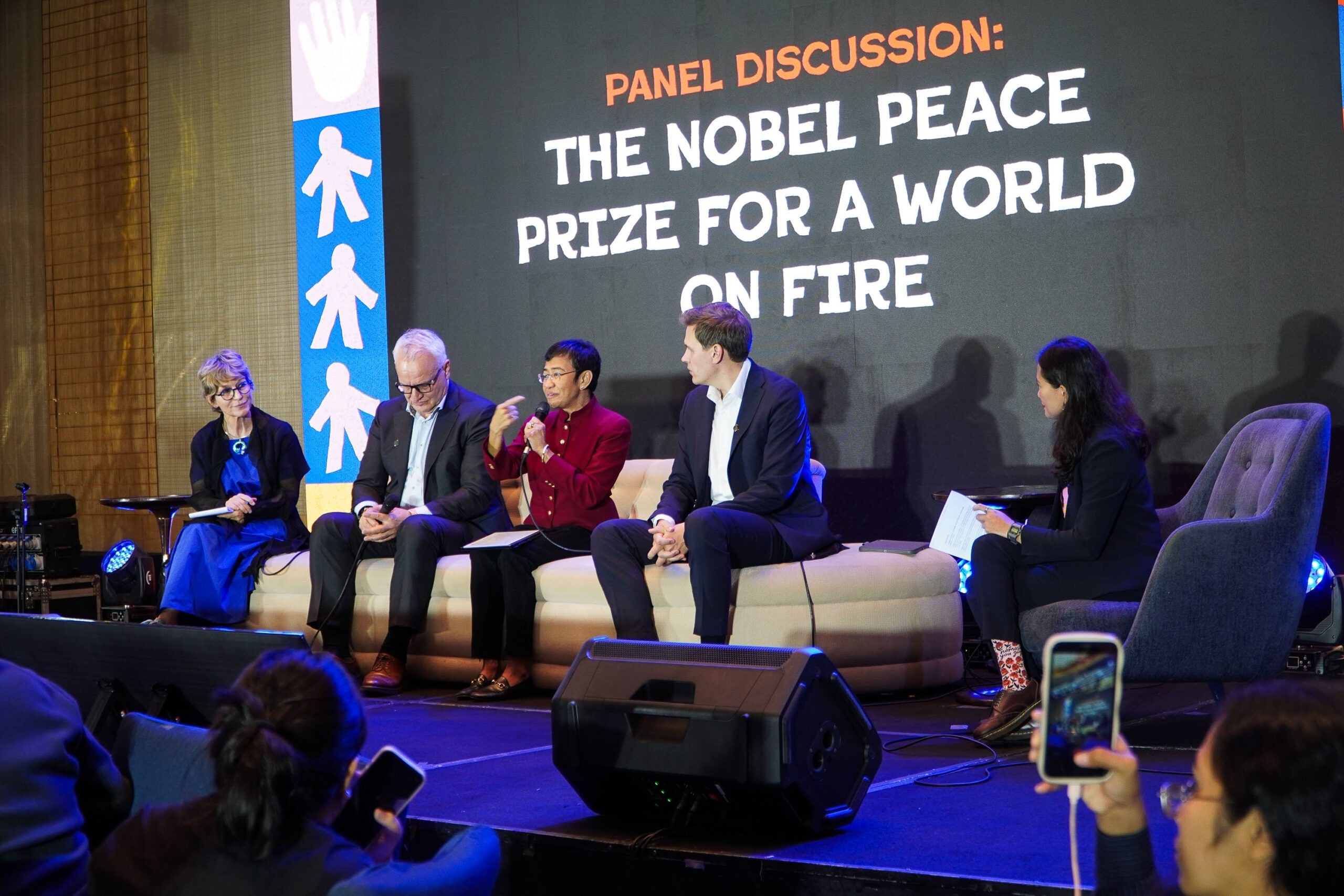
Global human rights leaders called for collective action against artificial intelligence threats at Rappler’s Social Good Summit in Manila on Saturday, November 21, 2026.
The speakers urged people to organize, document abuse and cooperate across borders rather than leave decisions about AI to technology companies and governments, according to Rappler’s summit report. Their shared position was direct: resistance can succeed when isolated citizens become organized communities.
A call to organize, not surrender
Amnesty International spokesperson Agnes Callamard made that case when asked how the public could defend human rights against the profit-driven race to develop AI. She described the public as part of a global majority willing to stand up to Big Tech.
“Resistance matters, resistance can work,” Callamard said.
“We must get together. Join organizations,” she added. “Collectively, we can fight back and hold the line.”
Her answer placed responsibility beyond individual consumer choices. A person can adjust privacy settings or leave a platform, but the summit’s closing panel argued that durable pressure requires associations capable of gathering evidence, supporting victims and demanding accountability.
That message has a familiar expression in Filipino life: bayanihan. Its value here is not sentiment but practical strength. Parish networks, workers’ groups, student organizations and rural cooperatives can give people a place to test information, seek help and speak with a louder common voice.
How Maria Ressa turned online attacks into evidence
Callamard recalled the instant online hatred directed at Navi Pillay after Pillay was announced as the most recent Nobel Peace Prize winner. Callamard said the experience was familiar to her and fellow panelist Maria Ressa.
Both women faced online harassment during the Duterte administration and publicly criticized former president Rodrigo Duterte’s bloody drug war. Callamard previously served as United Nations special rapporteur on extrajudicial executions, while Ressa received the Nobel Peace Prize in 2021.
Ressa said the scale of abuse against women in the Philippines became material for investigation rather than a reason to retreat.
“Women were attacked in the Philippines in 2017 at least 10 times more than men. What we did is we took the attacks down. It’s a curse because you feel it, but a blessing because you have the data,” Ressa said.
“We studied it. We learned how to do it, and we turned it into a system where we can help others,” she added.
Her account drew a line between enduring harassment and studying its operation. Documentation can reveal repeated methods, coordinated behavior and targets who need protection. It also gives journalists, researchers and civil society groups evidence they can use when platforms or public officials dismiss abuse as scattered noise.
AI, warfare and the need for coalitions
Rappler head of community Pia Ranada moderated the closing panel, which also examined how AI has made warfare more efficient. Kristian Berg Harpviken, director of the Norwegian Nobel Institute, said courage and integrity remain visible in both physical wars and conflicts over the limits of AI.
“There is no lack of organizations that are fighting back. And in the situation we are now, I think they are just more important than ever,” Harpviken said.
Jørgen Watne Frydnes, chairperson of the Norwegian Nobel Committee, said successful campaigns often grow from coalitions willing to set aside internal differences and move beyond a purely local perspective.
“What I hear is cooperation, it’s the necessity to cooperate, to lift your own perspective from your regional or local to global. And many of those campaigns that have succeeded, that did receive the Nobel Peace Prize, were campaigns that were able to take away the differences they had between them,” Frydnes said.
“Even though under our hardships, our trauma, war, terror, we continue, we continue as human beings. And that is a strength which is so inspirational,” he added.
The argument does not ask communities to abandon local concerns. It asks them to recognize that the same platforms, automated tools and information operations cross national boundaries. A response confined to one city, province or language group can miss the wider system producing the harm.
Ressa’s warning about predatory AI
During the plenary session titled “WE, THE HUMANS: Reclaim Our Future,” Ressa described AI as predatory and extractive and called for urgent regulation, Head Topics reported. She warned that the technology threatens the foundations of democratic society.
That warning sharpens the stakes behind Callamard’s call to organize. Regulation requires public pressure and informed institutions, while public pressure requires citizens who can connect personal experiences to a broader pattern of abuse.
For the Philippines, this is not a debate reserved for Manila’s technology sector. Automated systems can affect what provincial voters see, how small businesses reach customers and whether teachers, farmers or local journalists can trust material circulating online. Communities speaking Cebuano, Ilocano, Hiligaynon, Waray and other languages also need their experiences included when harms are investigated.
The panel did not offer a complete Philippine legislative program. It offered a starting discipline: join with others, preserve evidence and insist that human dignity set the boundaries of technological power.
Questions about the Social Good Summit
What was the theme of Rappler’s 2026 summit?
The theme was “We, The Humans.” Rappler said it highlighted human rights, values and community in the age of artificial intelligence.
Who joined the closing panel?
The speakers included Agnes Callamard, Maria Ressa, Kristian Berg Harpviken and Jørgen Watne Frydnes. Rappler’s Pia Ranada moderated the discussion.
What response to AI threats did the speakers propose?
They called for organized collective action, wider cooperation and the documentation of online abuse. Ressa also urged urgent regulation of AI.