
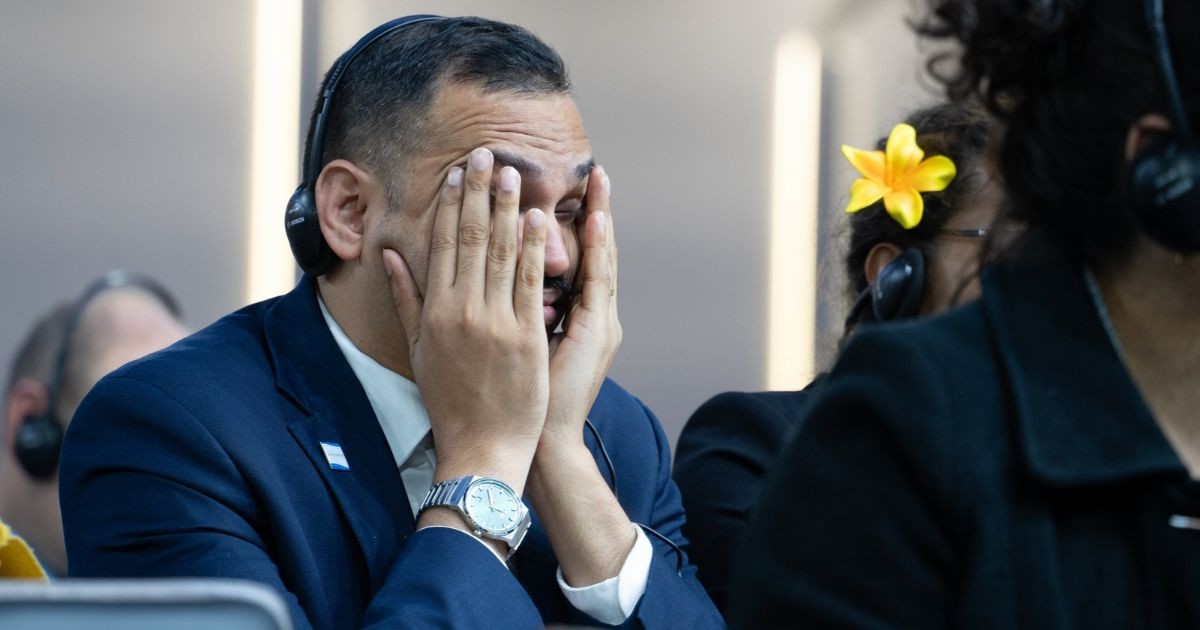
United Nations climate talks in Antalya, Turkey, collapsed on Sunday, Nov. 22, 2026, after the European Union and allied governments rejected a final deal over fossil fuels and finance.
The draft presented by COP31 presidents Turkey and Australia made no mention of fossil fuels, according to GMA Network. Developing countries also said its finance provisions were too vague to help them adapt to rising temperatures.
Why the COP31 climate deal failed
More than two weeks of negotiations ran two days into overtime, making COP31 the longest U.N. climate conference on record. Turkey’s conference president, Murat Kurum, told the closing plenary that he would not put forward another text.
“There is nothing to do. We did all that we could,” Kurum said.
He later left the stage while country representatives were still delivering speeches. Australia’s COP31 president of negotiations, Chris Bowen, called the outcome “very disappointing” and identified disagreements over fossil fuels and climate finance as the main obstacles.
The European Union, Britain and developing-world allies rejected the draft as unacceptable, The Guardian reported. The BBC said the fourth draft failed because it did not state a need to move away from fossil fuels, the largest source of global warming.
Ireland’s environment minister, Darragh O’Brien, said the European Union could not support an agreement that avoided the central cause of the crisis.
“It is unconscionable that we would have a climate act that makes no reference to fossil fuel, no reference to transitioning away from fossil fuels,” O’Brien said.
Saudi Arabia and other major oil producers had lobbied to keep fossil fuels out of the text, observers at the summit said. Those governments maintain that oil and gas will remain part of the economy for the foreseeable future.
A Saudi representative told the closing plenary that he was surprised by the resistance to what his delegation considered a concrete response to global warming.
Carbon removal, finance and electricity targets
The rejected text acknowledged that global temperatures are projected to overshoot the Paris agreement’s 1.5 degrees Celsius limit. It called for faster development of carbon-removal technology to reverse that overshoot eventually.
Scientists say carbon removal, combined with steep emissions cuts, is necessary to avoid the worst effects of climate change. Critics feared that the draft’s language could instead give oil producers permission to continue extraction while promising to clean up emissions later.
Developing countries raised a separate objection: money. The draft called for a tripling of finance to help vulnerable nations adapt, but it did not identify the baseline from which that increase would be measured.
Turkey also proposed raising electricity’s share of total final world energy consumption to 35% by 2035, from about 23% now. Supporters said the target could reduce greenhouse gas emissions by replacing fuel-powered cars, furnaces and other equipment.
Opponents warned that poorer nations could bear higher costs without receiving a clear route away from fossil fuels or enough financial support.
What the collapse means for the Philippines
For the Philippines, the dispute is not an abstract quarrel among diplomats. Heatwaves, floods, wildfires and stronger storms are already forcing governments worldwide to compete for money and attention while wars and economic pressures drain both.
Filipino farmers, fishing communities and local governments need predictable finance for adaptation, not a pledge to triple spending from an unknown starting point. Clear baselines and transparent accounting would allow the public to test whether wealthy countries deliver what they promise.
Lidy Nacpil, coordinator of the Asian Peoples’ Movement on Debt and Development, directed criticism at both the draft and the European Union. She said European governments demand language on fossil fuels while refusing to meet their legal obligation to provide climate finance.
“The cover decision fails humanity, particularly the people of the Global South, on many fronts that the EU chooses to ignore,” Nacpil said.
She said the co-presidencies, the European Union and other rich countries should be held accountable for the time lost at COP31.
“The fight will go on,” Nacpil said.
Her intervention gives the Philippine debate a necessary edge. A fossil-fuel phaseout without finance can shift costs onto countries with the least resources. Finance without a credible emissions plan can leave those same countries paying repeatedly for damage they did little to cause.
A setback for climate cooperation
U.N. Secretary-General Antonio Guterres expressed dismay after the talks ended without agreement.
“I share the very profound frustration of all those who expected governments to rise to the moment the climate crisis demands,” Guterres said.
The last U.N. climate conference that failed to secure adoption of a deal by all countries was Copenhagen in 2009. Recent summits have often been contentious, but analysts say they have guided business investment and encouraged growth in renewable power and electric vehicles.
They may also have limited warming. When governments reached the Paris agreement in 2015, existing policies pointed toward roughly 4 C, or 7.2 degrees Fahrenheit, of warming this century. A decade later, the projection is 2.8 C. The Paris agreement seeks to limit warming to 1.5 C, equivalent to 2.7 F.
COP31 was the first summit since the U.N. environmental body confirmed in October that global temperatures were set to overshoot 1.5 C. Scientists say extreme weather becomes more severe beyond that level.
Belgium’s climate minister, Jean-Luc Crucke, described the outcome as difficult but “not the end of multilateralism.”
“There has to be courage to say no,” Crucke said.
The failure in Antalya does not cancel obligations adopted at earlier U.N. conferences. The COP process remains the principal forum for coordinating emissions cuts and financing responses to climate damage.
Frequently asked questions
Why did the European Union reject the COP31 deal?
The European Union objected because the final draft did not mention fossil fuels or a transition away from them. Developing countries separately criticized the absence of a clear baseline for its proposed tripling of adaptation finance.
Does the collapse cancel the Paris climate agreement?
No. The absence of a political declaration in Antalya does not erase commitments adopted at previous U.N. climate conferences, including the 2015 Paris agreement.
What electricity target was included in the rejected text?
The draft proposed increasing electricity’s share of total final global energy consumption from about 23% to 35% by 2035.